Zero Trust Security in the Cloud: A Practical Implementation Guide
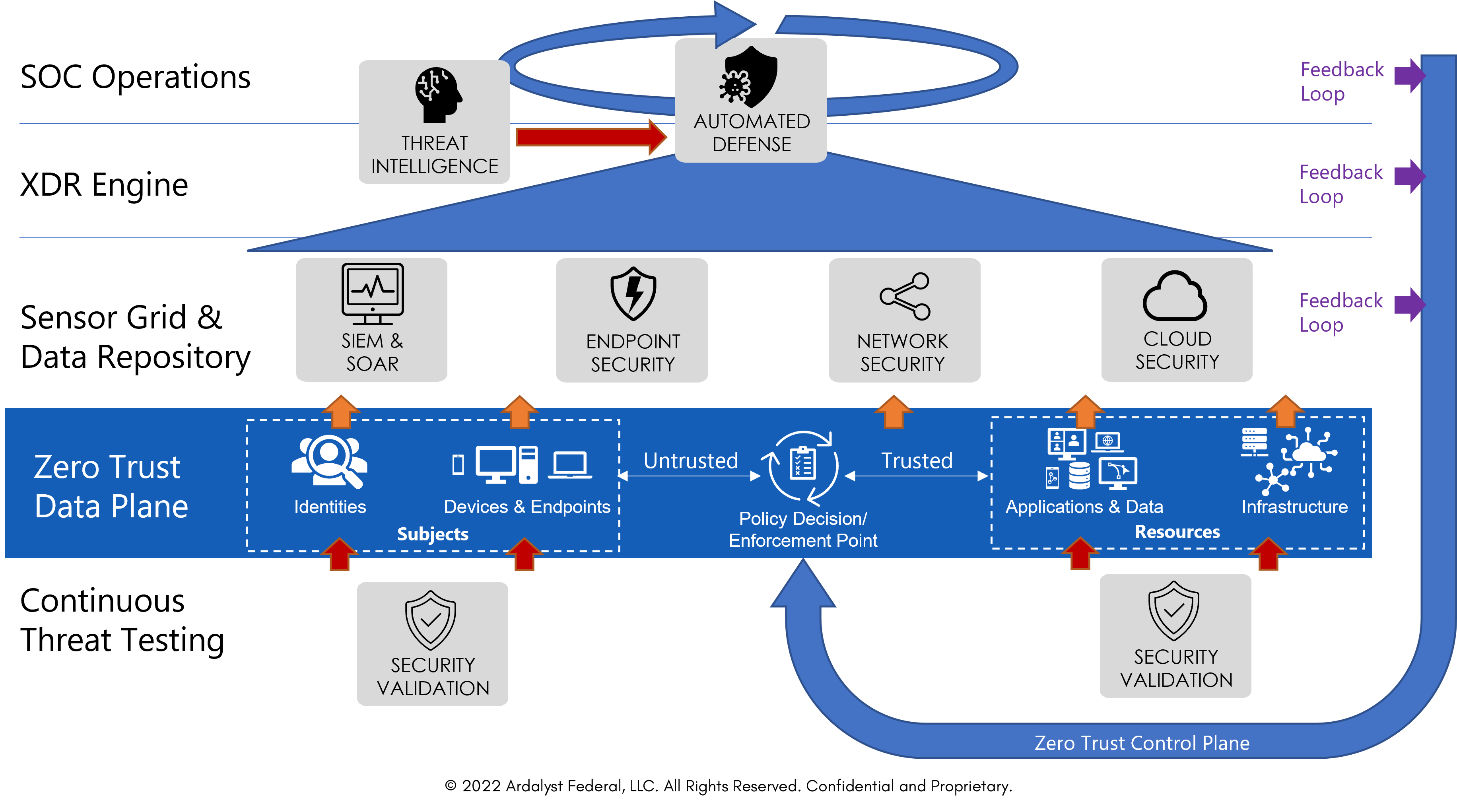
Why Perimeter Security Fails in the Cloud
Traditional security models assume everything inside the corporate network is trusted. In cloud environments, there is no perimeter. Workloads run across regions, developers access systems from anywhere, and third-party integrations create countless entry points. Zero Trust operates on a simple principle: never trust, always verify.
The Five Pillars of Zero Trust
1. Identity
Identity becomes the primary security perimeter. Every access request — human or machine — must be authenticated and authorized:
- Implement MFA for all human access (phishing-resistant methods like FIDO2 preferred).
- Use short-lived credentials for machine-to-machine communication.
- Implement just-in-time (JIT) access for privileged operations.
- Centralize identity management (AWS IAM Identity Center, Okta, or Azure AD).
2. Network
Microsegmentation replaces flat networks:
- VPC segmentation with private subnets for workloads.
- Security groups and NACLs as the first layer of defense.
- Service mesh (Istio, Linkerd) for mTLS between microservices.
- DNS-based service discovery instead of IP-based routing.
3. Devices
Device posture must be verified before granting access:
- Endpoint detection and response (EDR) integration.
- Device compliance checks (OS version, encryption status, patch level).
- Conditional access policies based on device risk score.
4. Applications
Applications must authenticate and authorize every request:
- API gateways with rate limiting and request validation.
- OAuth 2.0 / OIDC for application-level authorization.
- Web Application Firewalls (WAF) for public-facing applications.
- Container image scanning and runtime protection.
5. Data
Data protection is the ultimate objective:
- Encryption at rest and in transit (TLS 1.3 minimum).
- Data classification and DLP policies.
- Access logging and audit trails for all data operations.
- Backup encryption and cross-region replication for resilience.
Implementation Roadmap
Zero Trust is a journey, not a destination. A realistic timeline:
- Quarter 1 — Identity foundation: MFA, SSO, IAM policy review.
- Quarter 2 — Network segmentation and logging infrastructure.
- Quarter 3 — Application-level controls and API security.
- Quarter 4 — Data classification, DLP, and continuous monitoring.
Conclusion
Zero Trust is not a product you buy — it is an architecture you build. Start with identity (the highest-impact pillar), and expand systematically. The organizations that implement Zero Trust today will be the ones that avoid tomorrow's breaches.