Generative AI in the Enterprise: A Practical Guide to Real-World Applications
The State of Generative AI in 2026
Generative AI has moved past the initial wave of excitement. The novelty of chatbots and image generators has faded, and enterprise leaders are asking the right question: where does GenAI deliver real, measurable ROI?
After implementing GenAI solutions across dozens of enterprise clients, we have a clear picture of what works, what does not, and what separates successful deployments from expensive experiments.
Use Cases That Deliver ROI
1. Internal Knowledge Management
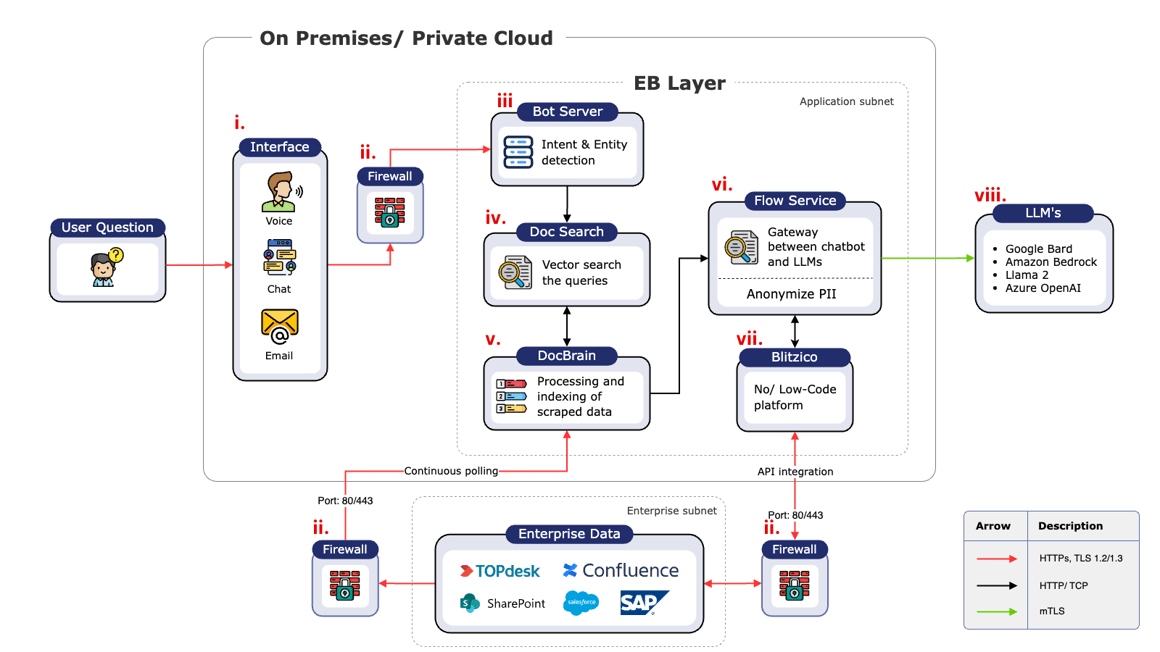
The highest-impact GenAI use case is not customer-facing — it is internal. Enterprises sit on vast repositories of documentation, policies, SOPs, and institutional knowledge spread across SharePoint, Confluence, email, and legacy systems.
- RAG-based knowledge assistants that let employees query internal documentation in natural language, with cited sources.
- Onboarding acceleration — new hires get answers in seconds instead of days spent searching or asking colleagues.
- Typical ROI: 30-40% reduction in time spent searching for information. For a 500-person organization, that translates to thousands of recovered productive hours annually.
2. Code Generation and Developer Productivity
Developer tools powered by LLMs are now mature enough for enterprise adoption:
- Code completion and generation — GitHub Copilot, Amazon CodeWhisperer, and custom-tuned models accelerate development by 25-35%.
- Code review automation — LLMs identify bugs, security vulnerabilities, and style violations before human review.
- Legacy code modernization — Translating COBOL, PL/SQL, or legacy Java to modern languages with AI assistance.
- Documentation generation — Automatic API docs, README files, and inline comments from code analysis.
3. Customer Service Automation
GenAI chatbots have matured significantly, but success requires careful implementation:
- Tier-1 support automation — Handle 60-70% of customer inquiries without human intervention.
- Agent augmentation — Real-time suggestions and draft responses for human agents handling complex cases.
- Multilingual support — Serve customers in 30+ languages without dedicated multilingual teams.
- Sentiment analysis and routing — Detect frustrated customers and escalate proactively.
4. Document Processing and Extraction
Structured data extraction from unstructured documents is a proven GenAI strength:
- Invoice and receipt processing — Extract line items, totals, and vendor information with 95%+ accuracy.
- Contract analysis — Identify key clauses, obligations, renewal dates, and risk factors.
- Regulatory compliance — Scan documents against regulatory requirements and flag gaps.
The Infrastructure Stack for Enterprise GenAI
Running GenAI at enterprise scale requires purpose-built infrastructure:
- Model serving — vLLM, TGI, or managed services (Amazon Bedrock, Azure OpenAI) for inference at scale.
- Vector databases — Pinecone, Weaviate, or pgvector for RAG retrieval pipelines.
- Orchestration — LangChain, LlamaIndex, or custom pipelines for multi-step AI workflows.
- Guardrails — Content filtering, hallucination detection, and output validation layers.
- Monitoring — Track latency, token usage, cost, accuracy, and user satisfaction per deployment.
Pitfalls to Avoid
- Starting with the wrong use case — Avoid high-stakes, regulated domains for your first GenAI project. Start with internal tools where errors are low-risk.
- Ignoring data quality — RAG systems are only as good as the knowledge base they query. Garbage in, hallucinations out.
- Underestimating costs — LLM inference at scale is expensive. Model every use case with realistic volume projections before committing.
- Skipping human-in-the-loop — For any customer-facing or decision-critical application, maintain human oversight and escalation paths.
Build vs. Buy Decision Framework
Not every GenAI capability needs to be built from scratch:
- Buy when the use case is well-defined and commercial solutions exist (code completion, basic chatbots, document extraction).
- Build when you need deep integration with proprietary data, custom models fine-tuned on domain knowledge, or competitive differentiation.
- Hybrid — Use commercial APIs for general capabilities and custom models for domain-specific tasks.
Conclusion
Generative AI is not magic — it is engineering. The enterprises seeing real returns treat GenAI as an infrastructure problem, not a science experiment. Start with high-impact, low-risk use cases, build robust infrastructure, and expand methodically. The competitive advantage belongs to organizations that operationalize GenAI, not those that simply experiment with it.