Designing a Cloud-Native Gaming Backend on AWS: Architecture Patterns
From Monolith to Microservices
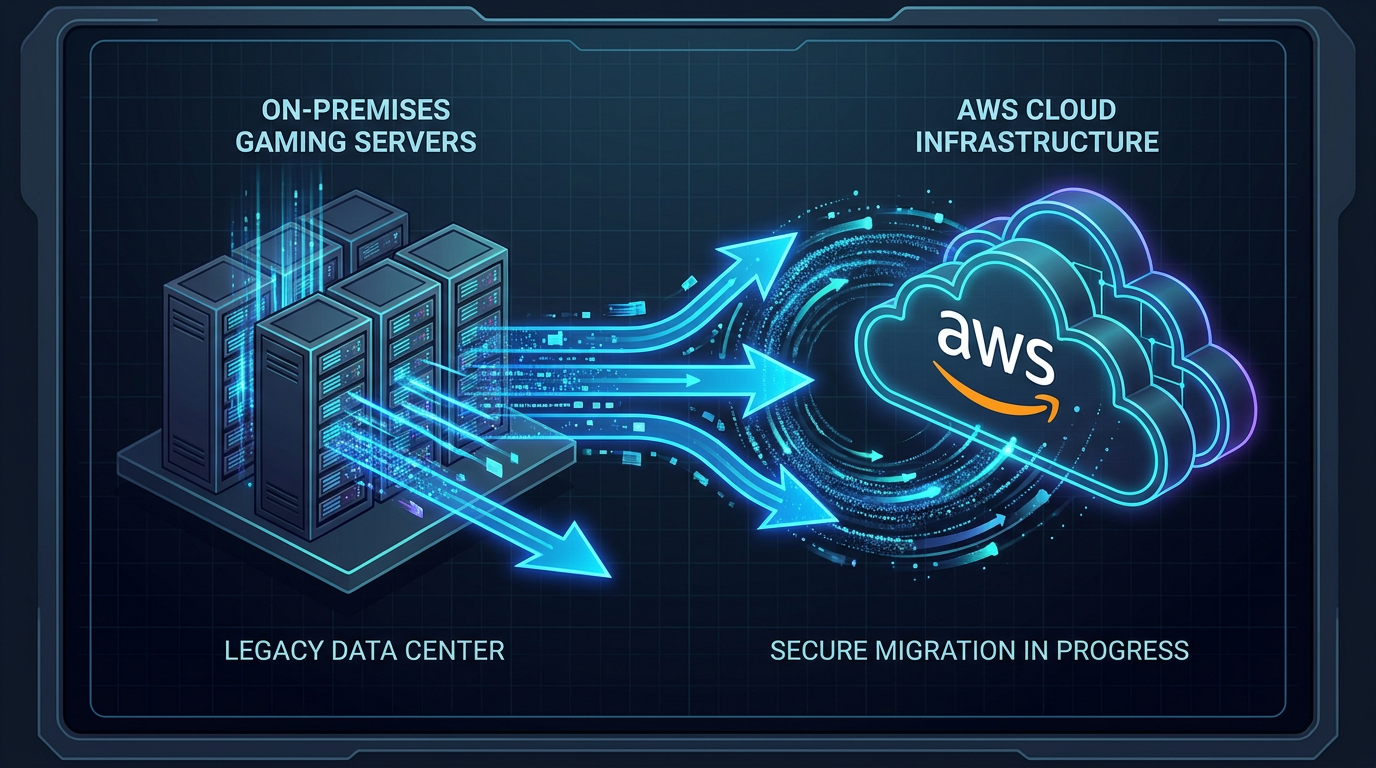
Traditional on-premises gaming backends are often monolithic — a single application handling authentication, matchmaking, game state, leaderboards, and analytics. This architecture worked when player counts were predictable and deployment cycles were monthly. In the cloud era, it becomes a bottleneck.
AWS enables a microservices approach where each backend component scales independently. A matchmaking spike during a tournament does not force you to scale your entire backend — only the matchmaking service.
Architecture Pattern 1: Matchmaking
On-premises matchmaking typically runs on a fixed pool of servers with custom algorithms. On AWS, the recommended pattern is:
- Amazon GameLift FlexMatch for rule-based matchmaking with configurable skill brackets, latency thresholds, and team composition rules.
- Amazon SQS as a queue buffer between matchmaking requests and game server allocation.
- AWS Lambda for custom matchmaking logic that extends FlexMatch (e.g., friend-of-friend priority, regional preferences).
This pattern handles 0 to 500,000 concurrent matchmaking requests without manual intervention.
Architecture Pattern 2: Player Data & Inventory
Player profiles, inventories, and progression data require sub-millisecond reads and strong consistency. The pattern:
- Amazon DynamoDB as the primary data store — single-digit millisecond latency at any scale.
- DynamoDB Streams to trigger downstream updates (analytics, anti-cheat, marketing triggers).
- Amazon S3 for player-generated content, replays, and large binary data.
- Amazon ElastiCache (Redis) as a write-through cache for frequently accessed data like active session state.
Architecture Pattern 3: Real-Time Communication
In-game chat, notifications, and live events require persistent WebSocket connections at scale:
- Amazon API Gateway WebSocket APIs for managed WebSocket connections.
- AWS AppSync for GraphQL subscriptions (ideal for lobby systems and social features).
- Amazon SNS for fan-out push notifications across platforms (mobile, desktop, console).
Architecture Pattern 4: Game Analytics Pipeline
On-premises analytics often means a SQL database that cannot keep up with telemetry volume. On AWS:
- Amazon Kinesis Data Streams to ingest millions of game events per second.
- Amazon Kinesis Data Firehose to deliver events to S3 data lake.
- Amazon Athena for serverless SQL queries on raw event data.
- Amazon QuickSight for dashboards — DAU, retention, monetization, session length.
Security Considerations
Gaming backends are prime targets for DDoS attacks, account takeovers, and exploit attempts:
- AWS Shield Advanced — DDoS protection with 24/7 response team.
- AWS WAF — Web application firewall for API protection.
- Amazon Cognito — Player authentication with MFA and social login support.
- VPC private subnets — Keep game servers and databases off the public internet.
Conclusion
A well-architected gaming backend on AWS replaces the rigid constraints of on-premises infrastructure with elastic, globally distributed services. The key is decomposing the monolith into independent services that can scale, deploy, and fail independently. Start with the patterns that address your biggest pain points — typically matchmaking and player data — and expand from there.